

E-mail:
david@wuyunconveyor.com

REQUEST A QUOTE
ENG
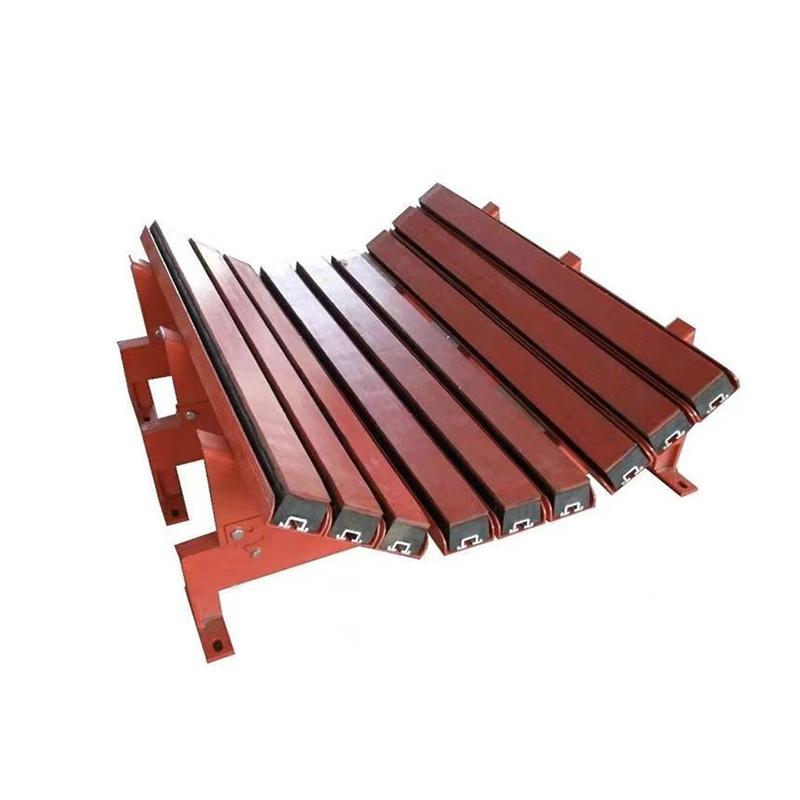
The Conveyor Impact Bed is a heavy-duty belt support system installed at conveyor loading points, transfer points, chutes, and hopper areas where bulk materials impact the conveyor belt.
Unlike traditional impact rollers, the impact bed provides continuous support across the belt width, helping distribute impact forces over a larger contact area. This design reduces belt deformation, minimizes damage caused by falling materials, and extends conveyor belt service life in demanding material handling applications.
The modular impact bar structure combines impact absorption and low-friction support, providing a stable conveying surface for heavy-duty conveyor systems.
Key Features
Continuous Belt Support
The impact bed provides a continuous support surface without gaps between rollers, reducing belt sagging and preventing material from becoming trapped between support components.
High Impact Absorption
Impact-resistant rubber bars absorb and distribute the energy generated by falling materials, helping protect the conveyor belt from impact damage.
Low-Friction Belt Support
The UHMW-PE surface of the support bars provides smooth belt movement with reduced friction, helping minimize belt wear during operation.
Modular Design
The modular structure allows convenient installation, replacement, and maintenance, reducing conveyor downtime.
Heavy-Duty Construction
The robust support frame and wear-resistant components provide reliable performance under demanding loading conditions.
Product Advantages
Protects conveyor belts: Reduces impact damage at loading and transfer points.
Improves belt support: Provides continuous support across the loading area.
Reduces belt wear: Smooth support surface minimizes friction between belt and support system.
Handles heavy impact loads: Suitable for applications involving large and heavy bulk materials.
Simplifies maintenance: Modular components allow easier replacement and servicing.
Extends conveyor service life: Helps reduce belt damage and unexpected downtime.
Applications
The Conveyor Impact Bed is mainly installed at conveyor loading points where materials are transferred from chutes, hoppers, or feeders onto the conveyor belt.
Typical applications include:
Mining and Quarrying: Used for loading points handling ores, rocks, aggregates, and other heavy bulk materials.
Coal Handling: Protects conveyor belts at transfer stations where falling coal creates high impact loads.
Cement and Building Materials: Suitable for conveying limestone, clinker, sand, and other abrasive materials.
Ports and Bulk Material Terminals: Used in ship loading and unloading conveyor systems requiring reliable belt protection.
Steel and Metallurgy: Applied in heavy-duty conveying systems with high material impact.
Recycling and Waste Handling: Helps protect belts when transporting irregular and heavy materials.
Ordering & Quotation Information
Information Required for Quotation
Please provide the conveyor belt width, loading-point arrangement, impact conditions, conveyed material, installation position, required quantity, and available installation space. Photos or drawings of the transfer point are useful for confirming compatibility.
Technical Confirmation & Lead Time
We will confirm the impact bed according to belt width, loading conditions, material characteristics, installation arrangement, support requirements, and available space. Lead time depends on configuration, quantity, material preparation, and purchased components.
Packaging, Delivery & Quality
Packaging and delivery are arranged according to impact bed dimensions, weight, quantity, transportation method, and destination. Dimensions, support configuration, quantity, and packaging are checked before shipment.
FAQ
What is a Conveyor Impact Bed?
A Conveyor Impact Bed is a belt support device installed at conveyor loading points to absorb material impact and protect the conveyor belt.
Why use an impact bed instead of impact rollers?
Unlike impact rollers with gaps between individual rollers, an impact bed provides continuous belt support, improving impact distribution and reducing belt damage.
Where is an impact bed installed?
It is mainly installed below conveyor loading points, transfer chutes, and hopper discharge areas where materials fall onto the belt.
Can an impact bed reduce conveyor belt damage?
Yes. The impact bars absorb and distribute impact energy, helping reduce belt punctures, deformation, and premature wear.
Is an impact bed suitable for heavy materials?
Yes. It is designed for heavy-duty applications involving large, abrasive, or high-impact bulk materials.
How does an impact bed reduce maintenance?
The modular structure allows quick replacement of worn components and reduces downtime compared with more frequent belt repairs caused by impact damage.
|
Applicable belt width: |
650–2400 mm |
|
Applicable belt speed: |
≤4.5 m/s |
|
Impact bar material: |
UHMWPE (ultra-high molecular weight polyethylene) + rubber + steel base |
|
UHMWPE surface thickness: |
12.5 mm / 25 mm (optional) |
|
Rubber hardness: |
≤55 Shore |
|
Impact bar size: |
e.g. 320×260×75 mm |
|
Applicable temperature: |
-20°C ~ +90°C |
|
Material drop height: |
≥3 m |
technological innovation, keep improving
With ingenuity, we are committed to global sustainable development.
Professional Conveyor Manufacturer, Since 1998.
Mobile QR Code
News & Updates
Contact infor.
 Phone / Whatsapp:
 Tel: +86-0519-86511555
 E-mail: david@wuyunconveyor.com
 Add: No.16 Xinfa Road, Wujin District, Changzhou City, Jiangsu Province, China

 English