

E-mail:
david@wuyunconveyor.com

REQUEST A QUOTE
ENG
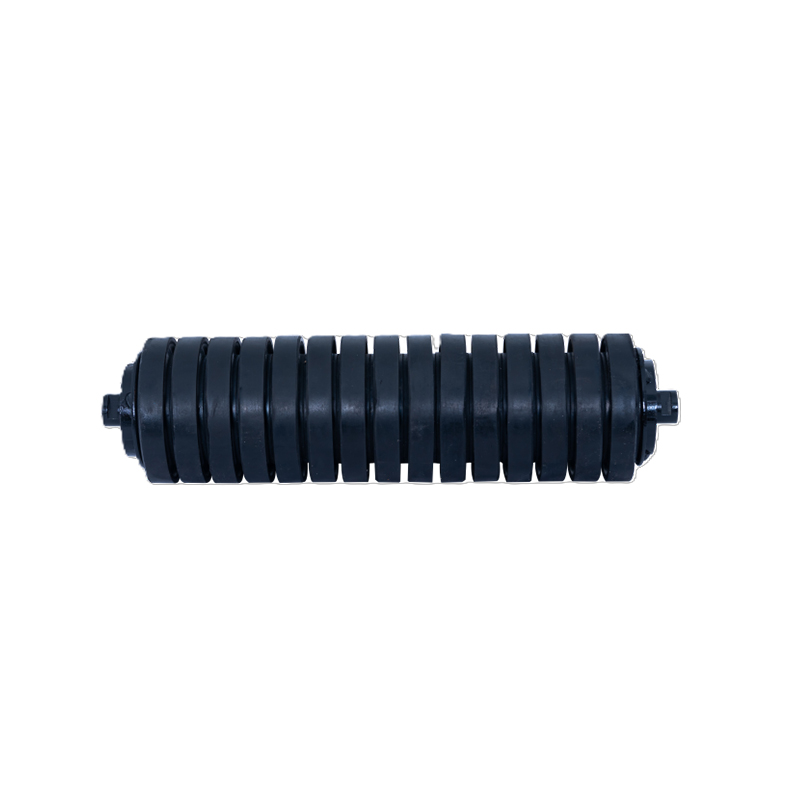
The Conveyor Impact Roller is designed for conveyor loading zones and transfer points where falling materials create concentrated impact on the conveyor belt. Its rubber discs provide a cushioning layer between the belt and roller, helping absorb impact energy and reduce stress on the belt when bulk materials are loaded from chutes, hoppers, or other transfer equipment.
The rubber-disc structure is mounted on a robust steel roller body to provide stable belt support under impact loading. The spacing between the rubber discs also allows fines and debris to pass through, helping reduce material buildup around the roller and maintain smooth rotation.
Key Features
Rubber Disc Impact Absorption
The rubber discs provide effective cushioning when bulk materials fall onto the conveyor belt. By absorbing part of the impact energy, the Conveyor Impact Roller helps reduce localized stress on the belt and its supporting structure.
Debris-Release Disc Arrangement
The gaps between the rubber discs allow fines and small debris to pass through rather than accumulating around the roller surface. This helps maintain smoother roller rotation and reduces material buildup in the loading zone.
Durable Roller Construction
The combination of a durable rubber compound and robust steel roller construction provides reliable resistance to wear and repeated impact during material loading operations.
Stable Belt Support
The impact roller provides continuous support beneath the belt at loading points while cushioning the effects of falling materials. This helps maintain stable belt operation in areas subject to repeated impact.
Product Advantages
Impact protection: Rubber discs absorb impact energy from falling materials and help reduce stress on the conveyor belt.
Reduced material buildup: Disc spacing allows fines and debris to pass through, helping keep the roller surface clear.
Wear resistance: The durable rubber compound is designed to withstand repeated contact and impact during conveying operations.
Belt protection: Reduced impact stress can help minimize belt damage and support longer belt service intervals.
Reliable loading-zone operation: The robust roller construction provides stable support in areas exposed to repeated material impact.
Applications
The Conveyor Impact Roller is installed beneath conveyor loading zones and transfer points where bulk materials are dropped onto the moving belt. It is particularly suited to applications where falling material can generate repeated impact loads and increase the risk of belt damage.
Typical applications include:
Bulk Material Handling: Used at loading and transfer points where bulk materials are continuously discharged onto conveyor belts.
Mining and Quarrying: Suitable for conveyor loading zones handling extracted materials, aggregates, and other bulk materials where repeated impact can occur.
Cement and Building Materials: Used beneath chute and hopper discharge points to cushion the impact of materials entering the conveyor.
Steel and General Industrial Plants: Supports conveyor loading areas where production or bulk materials are transferred onto belt conveyor systems.
Ports and Material Transfer Facilities: Suitable for transfer points where bulk materials are loaded onto or transferred between conveyor systems.
Crusher and Hopper Discharge Points: Provides impact cushioning beneath material discharge areas where falling material may place concentrated loads on the conveyor belt.
Ordering & Quotation Information
Information Required for Quotation
Please provide the conveyor belt width, impact roller diameter and length, shaft dimensions, installation position, required quantity, and loading-point conditions. Information about the conveyed material and impact conditions is useful for configuration confirmation.
Technical Confirmation & Lead Time
We will confirm the impact roller configuration according to the loading or transfer point, belt width, dimensional requirements, material characteristics, and operating conditions. Lead time depends on specifications, quantity, material preparation, and purchased components.
Packaging, Delivery & Quality
Packaging and delivery are arranged according to roller dimensions, quantity, transportation method, and destination. Products are inspected according to confirmed requirements before shipment.
FAQ
What is a Conveyor Impact Roller used for?
A Conveyor Impact Roller is installed at conveyor loading zones and transfer points to support the belt and absorb the impact generated when bulk materials fall onto the conveyor.
How do the rubber discs protect the conveyor belt?
The rubber discs compress under impact and absorb part of the energy generated by falling materials. This helps reduce concentrated impact stress on the conveyor belt and supporting components.
Where are impact rollers typically installed?
Impact rollers are typically installed beneath conveyor loading zones, transfer points, chute discharge areas, and hopper outlets where material falls onto the moving belt.
Why are there gaps between the rubber discs?
The gaps allow fines and debris to pass through instead of accumulating on the roller surface. This helps reduce material buildup and supports smoother roller rotation.
What is the roller construction?
The roller uses a robust steel roller body fitted with durable rubber discs designed to provide cushioning and impact protection at conveyor loading points.
Can impact rollers help extend conveyor belt service life?
By absorbing impact energy and reducing localized stress caused by falling materials, impact rollers can help reduce impact-related belt damage and support longer belt service intervals.
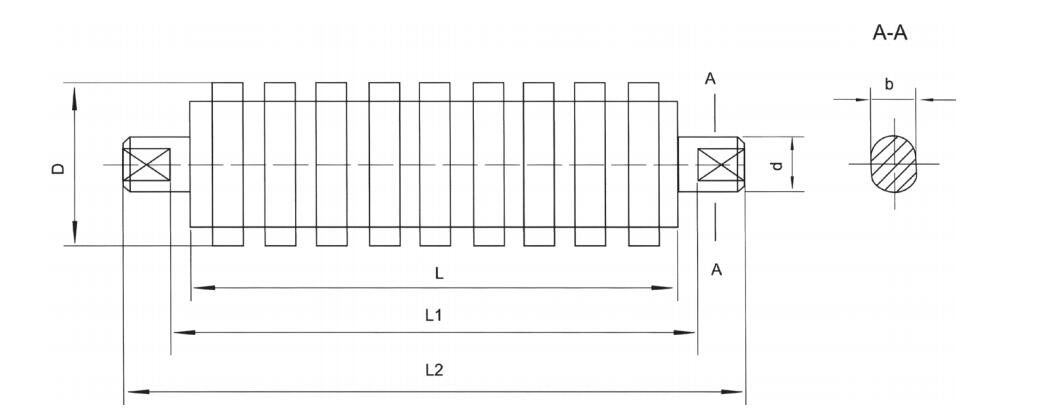
Unit: mm
| Belt width B | L | L1 | L2 | D | d | b | Bearing model |
| 500 | 190 | 200 | 218 | Φ89 | Φ20 | 14 | 4G204 |
| 650 | 240 | 250 | 268 | ||||
| 800 | 305 | 315 | 333 | ||||
| 1000 | 375 | 385 | 409 | Φ108 | Φ25 | 18 | 4G305 |
| 1200 | 455 | 465 | 489 | ||||
| 1400 | 525 | 535 | 559 |
| D | d | Bearing model | L | b | h | f | Weight of rotating | Drawing No |
| parts (kg) | ||||||||
| 89 | 20 | 4G204 | 200 | 14 | 6 | 14 | 2.82 | DTⅡGH1101 |
| 250 | 3.61 | DTⅡGH1102 | ||||||
| 315 | 4.64 | DTⅡGH1103 | ||||||
| 108 | 5.71 | DTⅡGH2103 | ||||||
| 25 | 4G205 | 18 | 8 | 17 | 6.57 | DTⅡGH2203 | ||
| 4G305 | 380 | 7.9 | DTⅡGH2304 | |||||
| 465 | 9.5 | DTⅡGH2305 | ||||||
| 530 | 11.43 | DTⅡGH2306 | ||||||
| 133 | 30 | 4G306 | 380 | 22 | 10.82 | DTⅡGH3404 | ||
| 465 | 11.72 | DTⅡGH3405 | ||||||
| 530 | 14.08 | DTⅡGH3406 | ||||||
| 159 | 465 | 15.34 | DTⅡGH4405 | |||||
| 530 | 17.76 | DTⅡGH4406 | ||||||
| 40 | 4G308 | 465 | 32 | 17.41 | DTⅡGH4605 | |||
| 530 | 20 | DTⅡGH4606 |
technological innovation, keep improving
With ingenuity, we are committed to global sustainable development.
Professional Conveyor Manufacturer, Since 1998.
Mobile QR Code
News & Updates
Contact infor.
 Phone / Whatsapp:
 Tel: +86-0519-86511555
 E-mail: david@wuyunconveyor.com
 Add: No.16 Xinfa Road, Wujin District, Changzhou City, Jiangsu Province, China

 English