

E-mail:
david@wuyunconveyor.com

REQUEST A QUOTE
ENG
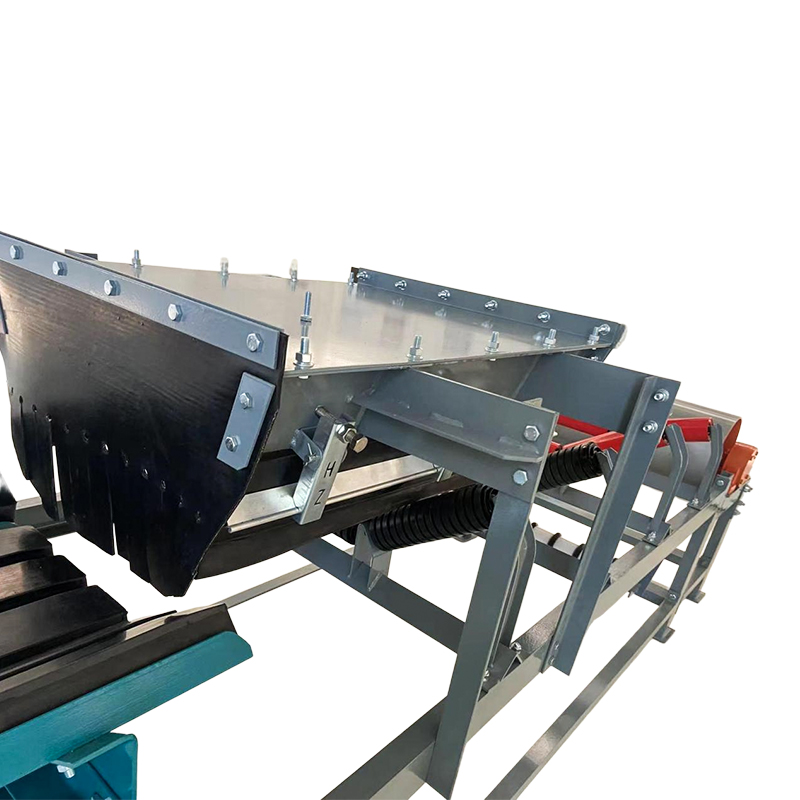
The Conveyor Hopper is a material receiving and transfer component used at the feeding or loading section of belt conveyor systems. It receives bulk material from upstream equipment and guides it onto the conveyor belt in a controlled and centralized flow.
The hopper helps regulate material discharge, reduce spillage, and maintain a stable loading profile at conveyor transfer points. Its robust construction makes it suitable for continuous bulk material handling in demanding industrial environments.
Key Features
Controlled material flow: Guides incoming bulk material toward the center of the conveyor belt for more stable loading.
Heavy-duty construction: Robust steel construction provides reliable support under continuous material loading and impact.
Transfer-point integration: Designed for installation at conveyor feeding and material transfer locations.
Wear protection options: Wear-resistant lining can be incorporated where required for handling abrasive bulk materials.
Application flexibility: The hopper structure can be configured according to material characteristics, conveying requirements, and installation conditions.
Product Advantages
Reduces material spillage by directing bulk material onto the conveyor belt.
Improves loading stability through controlled and centralized material feeding.
Supports continuous conveying in demanding bulk material handling systems.
Helps protect conveyor components by controlling the material flow at loading points.
Adaptable to different applications through configurable structure and wear protection.
Applications
The Conveyor Hopper is mainly used at conveyor feeding and transfer points where bulk materials need to be received, contained, and directed onto a belt conveyor.
Typical applications include:
Mining and Quarrying: Receiving and transferring ores, rock, aggregates, and other bulk minerals.
Coal Handling: Used at loading points for controlled transfer of coal and related bulk materials.
Steel and Metallurgy: Suitable for transferring raw materials such as ores and mineral-based feedstocks.
Cement and Building Materials: Used for controlled loading of limestone, clinker, aggregates, and other bulk materials.
Ports and Bulk Terminals: Supports material transfer between storage, loading, and conveying equipment.
Material Processing Plants: Used between crushers, screens, feeders, and belt conveyors to guide material flow.
Ordering & Quotation Information
Information Required for Quotation
Please provide the conveyor belt width, material type, feeding or transfer position, required hopper dimensions, material flow requirements, installation arrangement, required quantity, and operating environment. Wear conditions and dust-control requirements should be specified where applicable.
Technical Confirmation & Lead Time
We will confirm the hopper configuration according to belt width, material characteristics, feeding arrangement, material flow requirements, installation interface, available space, and operating conditions. Wear-resistant lining requirements can be confirmed according to the application.
Packaging, Delivery & Quality
Packaging and delivery are arranged according to hopper dimensions, weight, quantity, transportation method, and destination. Dimensions, configuration, quantity, appearance, and packaging completeness are checked before shipment.
FAQ
What is a Conveyor Hopper?
A Conveyor Hopper is a material receiving and transfer component that collects bulk material from upstream equipment and directs it onto a belt conveyor.
What is the main function of a conveyor hopper?
Its main function is to control and guide material flow onto the conveyor belt, helping reduce spillage and maintain stable loading.
Where is a conveyor hopper installed?
It is typically installed at conveyor feeding points, transfer stations, and other locations where bulk material is transferred to a belt conveyor.
Can a hopper be used for abrasive materials?
Yes. Wear-resistant lining can be incorporated for applications involving abrasive materials, helping protect the hopper structure from excessive wear.
What materials can be handled by a conveyor hopper?
It can be used for a wide range of bulk materials, including ores, coal, aggregates, limestone, and other mineral-based materials.
Can the hopper be customized?
The hopper structure can be configured according to the material flow, conveyor arrangement, installation conditions, and specific application requirements.
|
Volume range: |
0.5–20 m³ (common design ≥16.7 m³) |
|
Wall thickness: |
6–20 mm |
|
Main material: |
Carbon steel / Stainless steel |
|
Wear-resistant lining: |
NM500 / Ceramic / UHMWPE |
|
Minimum inclination angle: |
45° |
|
Discharge opening size: |
500×520 mm (customizable) |
technological innovation, keep improving
With ingenuity, we are committed to global sustainable development.
Professional Conveyor Manufacturer, Since 1998.
Mobile QR Code
News & Updates
Contact infor.
 Phone / Whatsapp:
 Tel: +86-0519-86511555
 E-mail: david@wuyunconveyor.com
 Add: No.16 Xinfa Road, Wujin District, Changzhou City, Jiangsu Province, China

 English