English
 简体中文
简体中文  Esperanto
  Afrikaans
  Català
  Cymraeg
  Galego
  繁体中文
繁体中文  Latviešu
  icelandic
  ייִדיש
  беларускі
  Hrvatski
  Kreyòl ayisyen
  Shqiptar
  Malti
Malti  lugha ya Kiswahili
  አማርኛ
አማርኛ  Bosanski
  Frysk
Frysk  ភាសាខ្មែរ
  ქართული
  ગુજરાતી
  Hausa
Hausa  Кыргыз тили
  ಕನ್ನಡ
ಕನ್ನಡ  Corsa
Corsa  Kurdî
Kurdî  മലയാളം
  Maori
Maori  Монгол хэл
  Hmong
Hmong  IsiXhosa
  Zulu
Zulu  Punjabi
  پښتو
پښتو  Chichewa
  Samoa
Samoa  Sesotho
  සිංහල
සිංහල  Gàidhlig
  Cebuano
  Somali
  Тоҷикӣ
  O'zbek
  Hawaiian
  سنڌي
سنڌي  Shinra
  Հայերեն
  Igbo
Igbo  Sundanese
  Lëtzebuergesch
  Malagasy
  Yoruba
  Español
  Português
  русский
  Français
  日本語
日本語  Deutsch
  tiếng Việt
  Italiano
  Nederlands
  ภาษาไทย
  Polski
  한국어
한국어  Svenska
  magyar
  Malay
Malay  বাংলা ভাষার
  Dansk
Dansk  Suomi
Suomi  हिन्दी
  Pilipino
  Türkçe
  Gaeilge
  العربية
  Indonesia
  Norsk
Norsk  تمل
تمل  český
český  ελληνικά
  український
  Javanese
  فارسی
فارسی  தமிழ்
தமிழ்  తెలుగు
  नेपाली
  Burmese
  български
  ລາວ
ລາວ  Latine
  Қазақша
  Euskal
  Azərbaycan
  Slovenský jazyk
  Македонски
  Lietuvos
  Eesti Keel
  Română
  Slovenski
  मराठी
मराठी  Srpski језик

Abstract
Belt conveyors in mining, cement, steel, fertilizer, and port operations face relentless abrasive and corrosive wear. The Ceramic Conveyor Idler has emerged as a transformative component for reducing belt damage, extending service intervals, and maintaining stable material flow. This guide examines the wear mechanisms that degrade conventional rollers, details the material properties that make alumina ceramic shells uniquely suited to high-abrasion environments, compares ceramic performance against steel and polymer alternatives, and provides selection, installation, and maintenance guidance for engineers seeking to optimize conveyor reliability across the full lifecycle of a bulk handling system.
- Why Do Traditional Conveyor Idlers Fail Under Abrasive Loads?
- What Makes Ceramic Conveyor Idlers Resistant to Wear and Corrosion?
- How Do Ceramic Idlers Compare with Steel and Composite Alternatives?
- When Should You Specify a Ceramic Conveyor Idler for Your System?
- How to Maintain Ceramic Idlers for Maximum Service Life?
- What Installation and Commissioning Practices Protect Ceramic Rollers?
- Frequently Asked Questions
Why Do Traditional Conveyor Idlers Fail Under Abrasive Loads?
Conveyor idlers are the most numerous rotating components in any bulk material handling system. A single overland conveyor may carry thousands of rollers along its length, each supporting the belt and its cargo through continuous rotation. When those rollers deteriorate, the consequences extend far beyond the idler itself. Belt misalignment, increased friction, material spillage, structural fatigue, and unplanned shutdowns follow in sequence, and each stage of degradation accelerates the next.
The root cause of premature idler failure in abrasive applications is a combination of mechanical wear and environmental attack. Steel idler shells, even those with protective coatings, gradually lose material as hard particles such as coal, ore, clinker, and slag pass over their surfaces. As the shell wears unevenly, it can develop a sharp edge that acts like a blade against the belt bottom cover. Once belt damage begins, the cost of remediation escalates rapidly, and the conveyor's availability suffers.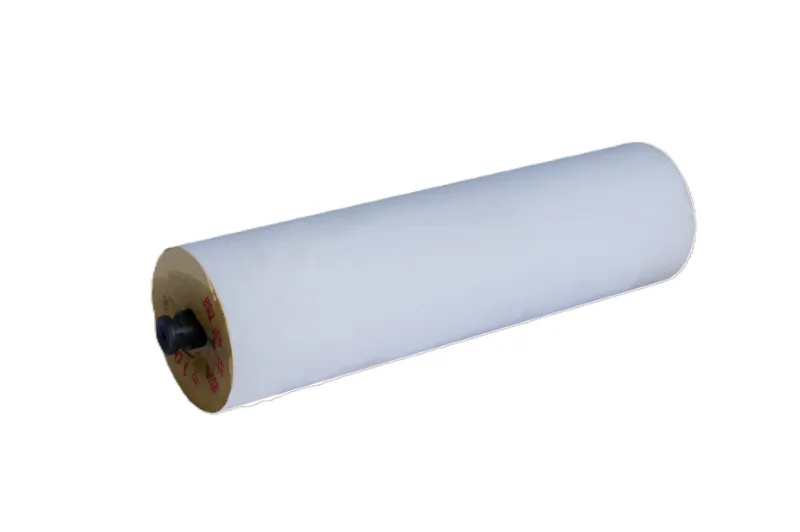
Three Modes of Idler Degradation in Harsh Environments
- Abrasive shell wear: Hard mineral particles entrained between the belt and idler surface act as a grinding medium, progressively thinning the roller wall and creating surface irregularities that transfer stress to the belt.
- Corrosive attack: Acidic or alkaline moisture, common in coal handling, fertilizer production, and coastal port operations, corrodes steel surfaces, accelerating material loss and weakening structural integrity.
- Bearing contamination: Dust ingress through inadequate seals leads to lubricant degradation, bearing seizure, and complete idler failure. A seized idler no longer rotates, becoming a stationary wear point that rapidly damages the belt.
Each failure mode compounds the others. A corroded surface is more susceptible to abrasive loss. A worn surface generates more dust that infiltrates bearings. A seized bearing transforms the idler from a support element into a destructive obstruction. Breaking this cycle requires a material solution that addresses all three vectors simultaneously rather than treating them as separate maintenance problems.
The Hidden Cost of Belt Damage
Engineers often evaluate idlers as a consumable cost line, but the true economic weight sits with the belt. A conveyor belt represents one of the largest single capital items in a bulk handling system, and its replacement requires extended downtime, heavy lifting equipment, and skilled splicing labor. When a worn idler shell develops a sharp edge, it removes belt cover material at an accelerating rate. The resulting belt damage is rarely visible until the cover is compromised enough to expose the carcass.
In high-tonnage operations, a belt that would otherwise deliver a decade of service can fail in half that time when idler-induced wear is not controlled. This is why idler selection should be treated as a belt protection decision, not simply a roller procurement decision. The surface condition of every idler in the carry run directly influences how long the belt survives.
Load Distribution and Roller Geometry
Idler failure is not purely a materials question. Trough geometry, spacing, and alignment determine how load is distributed across the belt and how much contact pressure each roller experiences. When idlers are spaced too widely or when a roller sits lower than its neighbors, the belt drapes into the gap, increasing localized stress and accelerating wear on both the belt and the affected roller.
- Correct trough angle: Matching the trough angle to the material's angle of repose prevents cargo shifting and reduces edge loading on the outer rollers.
- Consistent roller height: A roller that sits even a few millimeters low becomes a wear focal point, absorbing disproportionate load from the belt.
- Proper spacing: Carry idler spacing must account for belt weight, material weight, and the sag limit that keeps the belt within acceptable stress thresholds.
- Alignment discipline: A conveyor frame that is out of square forces the belt to run against idler flanges, generating friction and premature failure on both sides.
What Makes Ceramic Conveyor Idlers Resistant to Wear and Corrosion?
Ceramic idler shells are manufactured from aluminum oxide, a material with a hardness approaching that of diamond on the Mohs scale. The ceramic is formed through high-temperature sintering, producing a dense, non-porous surface that resists both mechanical abrasion and chemical attack. Unlike steel, which relies on surface coatings for protection, the ceramic roller's wear resistance is intrinsic to its bulk material, so it cannot be scratched through to a softer substrate.
Material Properties That Define Performance
| Property | Alumina Ceramic | Carbon Steel | UHMW Polyethylene |
|---|---|---|---|
| Mohs Hardness | Grade 7 | 4 to 5 | 2 to 3 |
| Corrosion Resistance | Excellent against acid, alkali, salt | Poor without coating | Good |
| Surface Adhesion | Very low | Moderate to high | Low |
| Thermal Stability | Up to 200 °C | Limited by coating | Below 80 °C |
| Abrasion Life Index | 2 to 3 times steel | Reference baseline | 1.5 to 2 times steel |
| Impact Toughness | Moderate | High | High |
The table above highlights a critical distinction. Ceramic does not merely outperform steel in a single dimension. It delivers a combination of hardness, chemical inertness, and surface smoothness that no metallic or polymer alternative matches simultaneously. The ceramic surface also forms a stable oxide film that discourages material adhesion, so sticky or moist cargo does not build up on the roller face and throw the belt out of alignment.
Surface Engineering and Material Release
Adhesion is an underappreciated driver of idler failure. In applications handling clay, wet coal, or mineral concentrates, material can cling to steel roller surfaces, forming a lumpy layer that changes the effective diameter of the idler. A roller with a built-up lump rotates unevenly, induces belt vibration, and can force the belt to track to one side. Operators often respond by increasing tension or adjusting training idlers, which masks the symptom rather than resolving it.
The low surface energy of a polished ceramic shell reduces this adhesion dramatically. Material that would otherwise stick to a steel surface sheds under gravity and the natural flexing of the belt. Over time, this means fewer manual cleaning interventions, more consistent belt tracking, and lower drive power consumption because the belt is not being lifted over accumulated debris.
Bearing and Seal Design in Ceramic Rollers
A ceramic shell is only as good as the bearing assembly inside it. High-quality ceramic rollers use precision-machined bearing housings, labyrinth seals, and in some designs multiple sealing stages to exclude dust and retain grease. The bearing cavity is typically filled with a high-grade lithium or synthetic lubricant chosen for the operating temperature range.
- Labyrinth sealing: Non-contact seal paths create a tortuous route that blocks dust particles while allowing the shaft to rotate freely.
- Lip seal backup: A secondary contact seal provides a final barrier in extremely dusty conditions.
- Grease retention: Properly packed bearings maintain a lubricant film that prevents metal-to-metal contact and heat buildup.
- Shaft material: Corrosion-resistant shaft steel prevents the shaft from rusting and seizing inside the bearing bore.
How Do Ceramic Idlers Compare with Steel and Composite Alternatives?
Selecting an idler material requires balancing multiple performance criteria against the specific demands of the application. The comparison below draws on field observations from heavy-duty operations in mining, cement, and port handling, where idler reliability directly affects system availability and maintenance workload.
Service Life and Belt Protection Comparison
| Performance Factor | Ceramic Idler | Steel Idler |
|---|---|---|
| Typical Service Life | Up to 80,000 hours in abrasive service | 15,000 to 20,000 hours |
| Belt Cover Impact | Minimal, no sharp edge formation | Progressive cover loss once worn |
| Corrosion Behavior | Unaffected by acid or salt | Requires coating, still degrades |
| Material Build-Up | Self-shedding surface | Frequent accumulation |
| Noise Level | Approximately 15 dB lower | Reference baseline |
| Weight | Higher | Lower |
| Impact Tolerance | Moderate | High |
The data tells a consistent story across industries. In cement production lines, ceramic rollers have demonstrated service lives up to 80,000 hours, roughly four to five times that of conventional steel idlers. In coastal port applications, the corrosion immunity of ceramic means the rollers do not need protective coatings that would eventually fail. In coal handling, the reduced adhesion keeps belts tracking correctly without constant operator intervention.
Noise, Vibration, and Energy Consumption
Noise and vibration are often overlooked in idler specification, yet they are reliable indicators of system health. A worn steel idler with an irregular surface generates vibration that propagates along the belt and into the conveyor structure. This vibration loosens fasteners, fatigues welds, and increases the rate of bearing failure in neighboring rollers. It also creates a working environment that is uncomfortable and potentially hazardous.
Ceramic rollers run smoother because their surfaces remain dimensionally stable throughout their service life. The measured noise reduction of approximately 15 decibels compared with steel rollers is significant in enclosed transfer stations and tunnels where sound levels can exceed safe exposure limits. Lower vibration also means lower rolling resistance, which translates into reduced drive power demand over the length of a long conveyor.
Where Each Material Wins
- Ceramic: High-abrasion carrying runs, corrosive environments, high-temperature zones, and applications with material adhesion problems.
- Steel: Primary impact zones, low-abrasion service, and situations where the lowest initial cost is the dominant criterion.
- Polymer: Light-duty conveying, moderate abrasion, and applications where low weight and quiet operation matter more than thermal resistance.
- Rubber-disc: Loading points and transfer chutes where shock absorption is the primary requirement.
When Should You Specify a Ceramic Conveyor Idler for Your System?
Ceramic idlers are not a universal replacement for every roller in every conveyor. They deliver the greatest value when the operating environment imposes conditions that rapidly degrade conventional components. The following criteria help determine whether ceramic is the appropriate specification for a given position in the conveyor line.
High-Priority Applications for Ceramic Idlers
- High-abrasion materials: Coal, iron ore, copper concentrate, clinker, slag, and construction demolition waste contain sharp, hard particles that grind away steel surfaces.
- Corrosive environments: Fertilizer plants, chlor-alkali facilities, coastal ports, and any operation where moisture carries acidic or alkaline compounds onto the conveyor structure.
- High-temperature service: Coking plants, sinter plants, and cement kiln feed lines where conveyed material retains residual heat that degrades polymer or coated rollers.
- Material build-up problems: Sticky or moist cargo that adheres to steel rollers, causing belt misalignment and increased drive power requirements.
- Remote or difficult-access installations: Overland conveyors crossing terrain where maintenance access is limited and component replacement is expensive in labor hours.
Where Ceramic May Not Be the First Choice
- Primary impact zones: The area directly beneath a chute discharge requires impact-absorbing rollers. Ceramic idlers should be installed downstream, after the material stream has settled onto the belt.
- Light-duty clean applications: For conveying dry, non-abrasive materials in controlled environments, standard steel or polymer idlers may deliver adequate performance at lower initial cost.
- Systems with severe belt tracking issues: While ceramic idlers reduce adhesion-related misalignment, they do not correct structural alignment problems. Addressing frame square and training idler placement takes priority.
- Extreme shock loading: Operations where large lumps routinely fall onto the carry run require impact-rated rollers rather than hard ceramic shells.
For operations that fall within the high-priority categories, specifying a Ceramic Conveyor Idler represents a targeted engineering decision rather than a premium upgrade applied indiscriminately. The correct approach is to map the conveyor's wear profile and install ceramic rollers at the positions where abrasion, corrosion, or adhesion are most severe.
Calculating the Specification Boundary
A practical method for deciding where ceramic should be deployed is to divide the conveyor into zones based on exposure. The loading zone is treated separately and specified with impact rollers. The first fifty meters downstream of loading typically experience the highest abrasion because material is still settling and fines are still airborne. The mid-run experiences steady-state wear. The discharge and return run experience their own distinct wear patterns.
Ceramic rollers offer the strongest return in the zones where abrasive wear is continuous and where belt damage would be most costly to repair. In many installations, a hybrid approach works best: impact rollers at the loading point, ceramic rollers through the high-wear carry sections, and standard rollers on the return run where loads are light and abrasion is minimal. This zoning strategy captures the performance benefit without over-specifying the entire conveyor.
How to Maintain Ceramic Idlers for Maximum Service Life?
Ceramic idlers require less frequent intervention than steel rollers, but they are not maintenance-free. A structured inspection program ensures that the benefits of ceramic technology are fully realized over the component's service life, and it catches the rare failure before it damages the belt.
Routine Inspection Checklist
- Visual rotation check: Confirm that each idler rotates freely by hand or with a portable rotation tool. A ceramic roller that has stopped rotating will wear flat on one side and lose its performance advantage.
- Surface condition assessment: Inspect the ceramic shell for chips, cracks, or glaze loss. Minor surface irregularities may be acceptable, but deep cracks that expose the shaft require replacement.
- Seal integrity verification: Ceramic idlers use labyrinth or lip seals to protect bearings. Check for lubricant leakage or dust ingress around the end caps, which indicates seal degradation.
- Belt tracking observation: Monitor belt position through the ceramic idler sections. A shift in tracking may indicate a seized roller or a change in material loading pattern.
- Fastener torque check: Verify that bracket bolts and frame connections remain tight. Vibration can loosen fasteners over time even when rollers are healthy.
Cleaning and Handling Guidelines
The smooth ceramic surface naturally sheds most material, but periodic cleaning may be required in sticky applications. Water, preferably softened, is sufficient to remove accumulated material. Do not use detergents or abrasive cleaning agents, because these can leave residues that promote adhesion and may attack the seal materials.
When handling ceramic idlers during installation or replacement, avoid striking the ceramic surface against hard objects. The material is hard but not impact-tough. A dropped idler may crack even when the damage is not immediately visible, and a cracked shell can fail suddenly once it is under load. Store spare rollers on padded racks and transport them in their original packaging whenever possible.
Bearing Lubrication Practices
Most ceramic idlers are supplied with sealed-for-life bearings, which means no field lubrication is required. However, in high-temperature or high-speed applications, some designs include grease fittings that allow periodic relubrication. When relubrication is specified, use only the lubricant grade recommended by the manufacturer. Mixing incompatible greases can cause the lubricant to break down, leading to bearing seizure.
What Installation and Commissioning Practices Protect Ceramic Rollers?
Even the best roller will underperform if it is installed incorrectly. Ceramic idlers are precision components, and the way they are mounted, aligned, and commissioned determines whether they deliver their full service life or fail prematurely from avoidable causes.
Alignment and Spacing Fundamentals
- Frame squareness: Verify that the conveyor frame is square and level before installing rollers. A frame that is out of square forces the belt to run against idler flanges, generating friction on both sides.
- Roller height consistency: Use a string line or laser level to confirm that all rollers in a section sit at the same elevation. A low roller becomes a wear focal point.
- Correct bracket orientation: Install brackets so that the roller sits squarely in the trough without twisting. A twisted roller causes uneven belt contact and accelerated wear.
- Proper spacing: Follow the engineering spacing schedule for the belt width and material load. Do not widen spacing to reduce component count.
Commissioning Checks After Installation
- Manual rotation test: Rotate every newly installed roller by hand before starting the conveyor. Any roller that does not spin freely must be investigated and corrected.
- Belt tracking run: Run the conveyor empty and observe belt tracking through the new roller sections. Make adjustments to training idlers before loading material.
- Loaded trial: Introduce material gradually and monitor belt position, motor current, and any unusual noise from the new roller positions.
- Thermal check: After several hours of operation, check bearing housings for excessive heat. Warm bearings indicate a lubrication or alignment problem.
- Documentation: Record the installation date, position, and roller type so that inspection intervals and replacement planning can be managed systematically.
A properly commissioned conveyor with ceramic rollers in the right positions will run quieter, track better, and require fewer interventions than a conveyor equipped entirely with steel rollers. The installation phase is where that reliability is either secured or squandered. Investing time in alignment and verification during commissioning pays back through years of stable operation.
Frequently Asked Questions
What is the primary advantage of a ceramic roller over a standard steel roller?
Can ceramic rollers be used in impact zones where material falls onto the belt?
How do ceramic rollers perform in high-temperature applications?
Are ceramic rollers suitable for abrasive materials such as iron ore and coal?
What maintenance does a ceramic conveyor roller require?
Do ceramic rollers reduce conveyor noise levels?
Can ceramic rollers be installed on an existing conveyor without modification?
How long do ceramic rollers typically last in cement or mining service?
Ready to specify rollers that protect your belt and stabilize your conveyor uptime?
Wuyun engineers ceramic conveyor rollers for mining, cement, steel, fertilizer, and port operations, with manufacturing experience spanning more than two decades.
Contact us